

The future of the textile industry will not be shaped by isolated promises, but by new kinds of materials and verifiable actions. Chemical safety, transparency and regulatory compliance are no longer competitive advantages. They are prerequisites for responsible textile manufacturing.
Brightplus is a Finnish green-tech company reshaping the future of materials through bio-based innovations. The company’s mission is simple yet ambitious:
Our mission is to rid the world of toxic coatings.
This mission is advanced through BrightBio®, a bio-based material developed by Brightplus for functional textile applications. It is designed to deliver protection and performance while meeting strict chemical safety and regulatory requirements.
What is BrightBio®?
BrightBio® is a next-generation bio-based material engineered for functional textiles. It combines high performance with verified chemical safety, without compromising aesthetics or compatibility with existing industrial manufacturing processes.
BrightBio® is PFAS-free, and its chemical composition has been independently tested and verified. The material is customisable to meet different technical requirements and applications, including bags, interior textiles and apparel.
BrightBio® is:
- developed for functional textile applications
- drop-in compatible with existing manufacturing processes
- produced from industrial sidestreams and waste-based raw materials
- designed to support the transition towards renewable and circular input materials
BrightBio® represents a material solution that enables safer choices already at the input material stage.
What does OEKO-TEX® ECO PASSPORT mean and why does it matter?
OEKO-TEX® ECO PASSPORT is a certification for chemicals, raw materials and coatings used in textile and leather production. It focuses on the earliest stage of the value chain by assessing the chemical safety and regulatory compliance of input materials.
Unlike product-focused certifications, ECO PASSPORT evaluates which materials are used in production and whether they comply with defined requirements for restricted and regulated substances.
The OEKO-TEX® ECO PASSPORT certification granted to the BrightBio® film confirms that the material has been:
- independently tested by a third-party institute
- assessed for compliance with legal requirements, including REACH
- verified against OEKO-TEX® restriction lists and defined limit values
- confirmed as suitable for use in industrial textile manufacturing
The certification is based on comprehensive chemical testing. BrightBio® has been analysed for PFAS compounds, heavy metals, formaldehyde, phthalates, APEOs and other regulated substances, and has met the required criteria in all evaluated categories.
How does this differ from OEKO-TEX® STANDARD 100?
OEKO-TEX® certifications are widely recognised, but they serve different purposes at different stages of the textile value chain.
OEKO-TEX® STANDARD 100 focuses on finished textile products and assesses potential harmful substances from the perspective of consumer safety.
OEKO-TEX® ECO PASSPORT, by contrast, applies to input materials before textile manufacturing begins. It supports a proactive approach to chemical management by enabling informed material choices already at the design and sourcing stages.
- OEKO-TEX® STANDARD 100 applies to finished textile products
- OEKO-TEX® ECO PASSPORT applies to chemicals, materials and coatings used in production
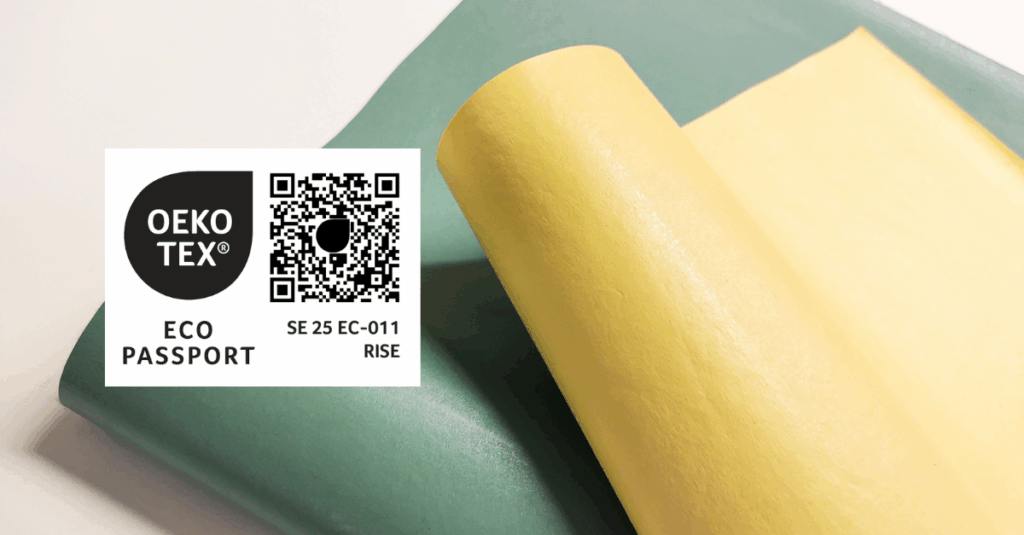
A certificate you can verify instantly via QR code
Each OEKO-TEX® ECO PASSPORT certified product is assigned a unique QR code. This allows the validity and scope of the certification to be verified directly within the OEKO-TEX® system.
BrightBio® film licence number: SE 25 EC-011
This supports transparency and traceability across the textile value chain.
A step towards a more responsible textile industry
At Brightplus, material development is guided by science, transparency and verifiable data. The OEKO-TEX® ECO PASSPORT certification for BrightBio® film is a concrete step towards a textile industry where chemical safety is addressed proactively at the input material level, rather than evaluated only after production.
The Lovia Kaiku bag is made using BrightBio® material.